

Individual assessment
Selfie-coach SOLO
Discover what really motivates me in a situation.
Discover Selfie-coach SOLOIndividual assessment
Discover what really motivates me in a situation.
Discover Selfie-coach SOLO
Individual assessment
Understand my state of mind so I can learn to adjust it.
Discover Selfie-coach PRO
Individual assessment
Explore in depth what influences my reactions so I can take action.
Discover Selfie-coach EXPERT
Specialised assessment
Compare the desired state of mind for a role with a candidate’s state of mind as they approach it.
Discover Selfie-coach MATCH
Specialised assessment
Understand what is at play between two people in their relationship.
Discover Selfie-coach DUO
Specialised assessment
Compare the state of mind I have with the one others perceive.
Discover Selfie-coach 360
Specialised assessment
Analyse a team’s collective state of mind in a situation.
Discover Selfie-coach TEAMThe Selfie-coach is a situational assessment that explores the state of mind of a person or a group facing a clearly identified situation. It answers one simple question: ‘How are you approaching this situation?’
Because our state of mind can change from one situation to another, the Selfie-coach does not try to lock a person into a personality profile. It helps you understand what is at play here and now, then observe how things change over time, so as to develop clear-sightedness and make adjustments easier.
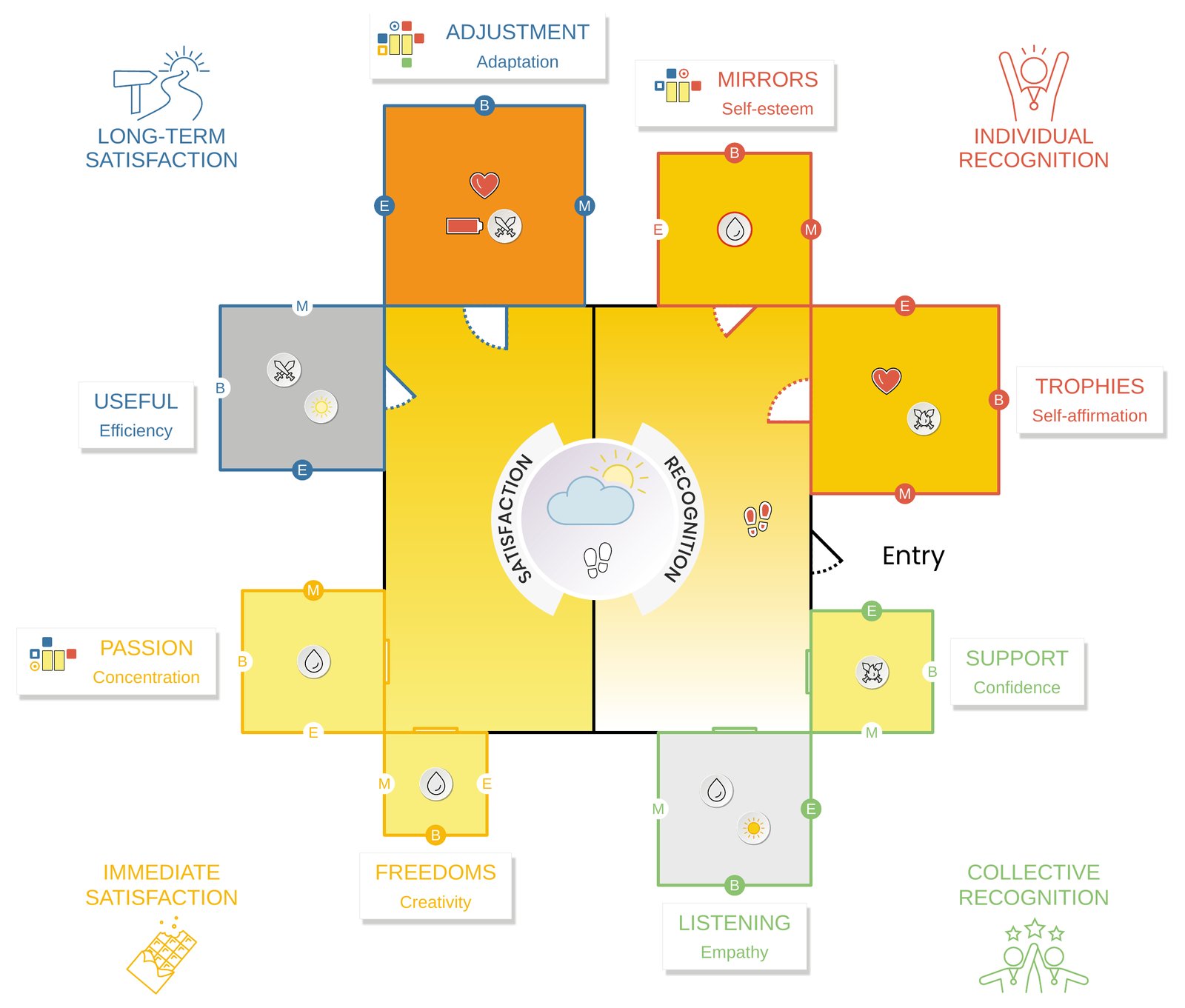
Knowing your personality is not enough to understand how we will react here and now. Being clear-sighted about the situation and its impact is the key that changes everything.
Depending on what is at stake, the context, the people present or our energy level, our state of mind can change profoundly. This happens instantly and can alter our motivations, emotions, values and behaviours in the moment.
The Selfie-coach is built on two proven principles: the memory palace, to memorise the method, and visualisation, to make it easier to experiment with different states of mind.
This is how the graphic representation of the state of mind as a floor plan came about. Moving mentally through this house makes it easier to change and to put those changes into practice.

We chose to make the main foundation of the Selfie-coach – psychology professor Michael Apter’s reversal theory – easier to apply, without losing any of its subtlety. The debriefing workbooks therefore give practitioners a clear and reassuring framework for using the different assessments.
The approach meets two needs.
Strategic: anticipating an upcoming situation and preparing for it.
Reactive: understanding what is at play at any given moment and adjusting.
To give access to a fine-grained understanding of the state of mind, so that you can anticipate accurately, react effectively and act at the right moment.
Selfie-coach assessments were designed by coaches who have held management positions.
The Selfie-coach draws mainly on the reversal theory of the psychologist Michael Apter. The approach turns his concepts into a visual, pragmatic and operational method, designed to be easy to use in real-life situations.
This site uses cookies. You can accept, reject or customise their use. Cookie policy